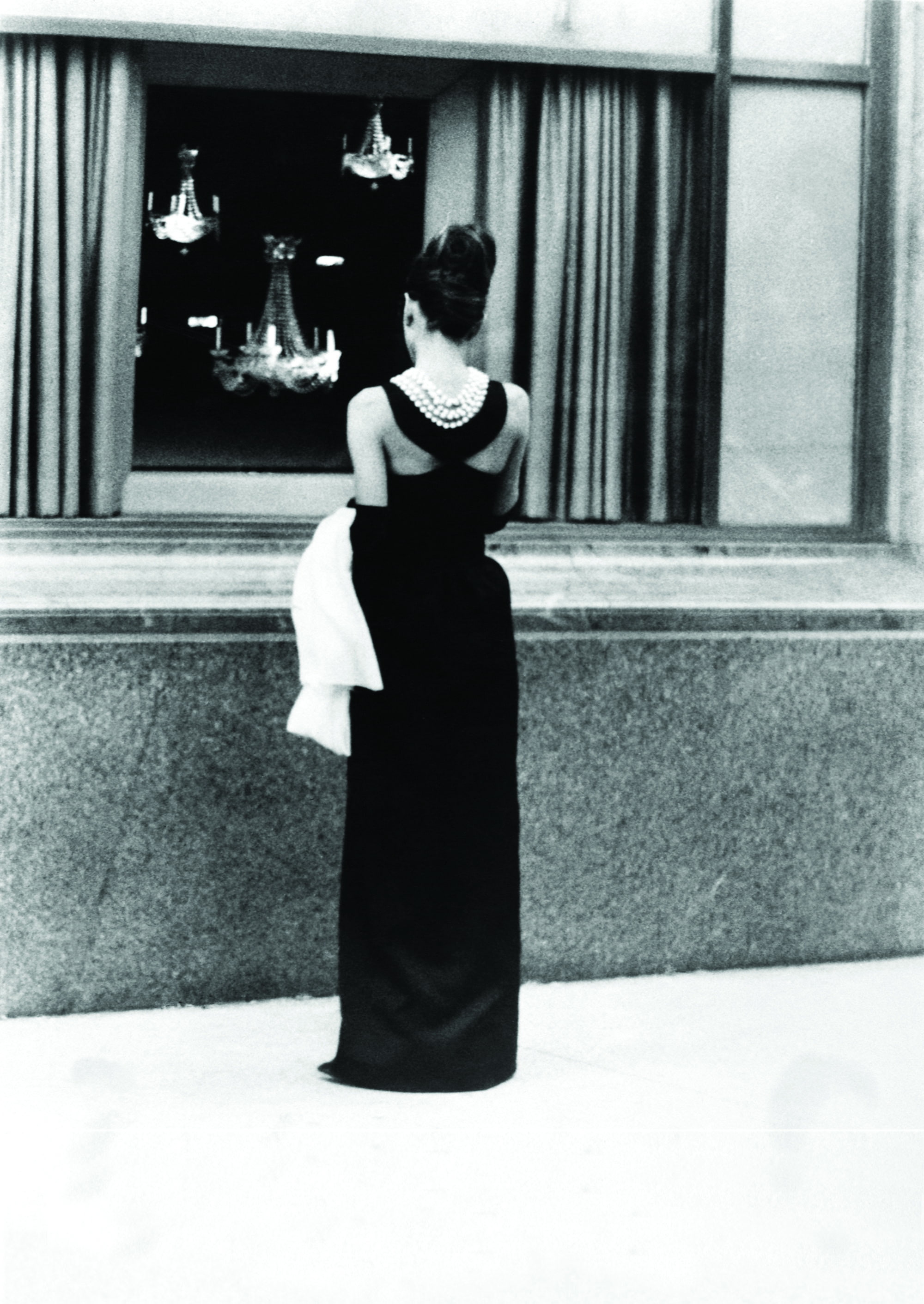
My love affair with Tiffany & Co. started many moon rivers ago, watching Breakfast At Tiffany’s on the Movie Channel in my parents’ wood-paneled Florida room, obsessing over Holly Golightly’s every move. Her black Givenchy sheath. Her blonde-streaked updo and tiara. The statement pearls cascading down the back of her gown.
Her blonde-streaked updo and tiara. The statement pearls cascading down the back of her gown.
Portrayed with gamine perfection by Audrey Hepburn, the eccentric heroine of Truman Capote’s mid-century novella had a unique way of beating the blues (and the more intense “mean reds”): Taking a taxi to Tiffany’s after a night ofvollv parties with her rich yet soulless suitors, finding solace by gazing into the pristine Fifth Avenue windows of her happy place, a takeout coffee in her opera-gloved hand. As she told “Fred, baby” in the iconic 1961 film, “Nothing very bad could happen to you there.”
Holly Golightly was right.
For nearly two centuries, America’s first luxury jewelry house—responsible for bringing rare and major gemstones to the US—has remained a sanctuary of serenity where shopping for jewelry and other pretty things has an air of calm that feels almost spiritual. Just perusing the gleaming vitrines, their contents arranged with museum-like precision, can put me in a meditative state. I’m not remotely kidding.
And then there’s the signature robin’s-egg blue Tiffany box, ribboned in white satin, which elevates gift-giving (and -receiving) to anticipatory heights, triggering a tsunami of dopamine at even a peripheral glance.
I can only imagine the love fest ignited by the blue box Richard Burton gave Elizabeth Taylor in 1964, containing a dazzling, stylized swimming fish encrusted with diamonds, gold scales, sapphire eyes and an emerald mouth. Designed by Jean Schlumberger for Tiffany & Co., the iconic The Night Of The Iguana brooch sold for a whopping $1.2 million at the actress’ landmark 2011 Christie’s auction in New York City.
Schlumberger, well-regarded in elite art circles for his surrealist buttons and costume jewelry for Parisian couturier Elsa Schiaparelli, joined Tiffany & Co. in 1956 with the distinction of being the first designer permitted to sign their own work. Two high-profile collaborators followed: Halston muse Elsa Peretti, in 1974, marking the first time in 25 years that Tiffany sold sterling silver jewelry; and Paloma Picasso (yes, the legendary artist’s daughter), in 1980, whose bold “Graffiti” jewelry collection had all the beautiful people wearing Xs and Os.
Lady Gaga had the ultimate red-carpet moment—and good-luck charm— when she wore the historic 128-carat Tiffany yellow diamond necklace, valued at $30 million, to the 2019 Oscars, where she won her first Academy Award. Actor Michael B. Jordan rocked two Tiffany “Bird On A Rock” vintage brooches designed by Schlumberger at the 2023 Oscars.
And the legacy company has partnered for a second year with the Council Of Fashion Designers Of America (CFDA) Jewelry Designer Award to “elevate the next generation of American jewelry designers.” Let’s just say Tiffany is here to stay.
If I were asked to name my favorite Tiffany possession—and there are many,
from a gold repoussé bamboo pen circa 1940s to an Art Nouveau femme-flower
pendant of forged silver—I’d like to think my top Tiffany trophy is still
waiting to be discovered. That is, unless I splurge on a vintage 18K gold Elsa
Peretti “Open Bottle” pendant necklace, which I’ve been lusting after for
years. Yes, that would make me very, very happy. Blue box and all.