

Read the full feature in Coldwell Magazine
View IssueIf you've ever stood in front of a touchscreen wall panel wondering whether pressing the wrong button might accidentally lower the blinds in the wrong wing, you're not alone. Even among the ultra-wealthy, "smart home" is often a misnomer, because without the right approach, the tech may quickly become more trouble than it's worth.
Enter Ellen Martin, a New York City-based residential architect who has been navigating the intersection of luxury living and home technology for more than three decades. She's designed brownstones for people who want every bell and whistle, second homes for clients who happily retreat to a world before screens, and everything in between.
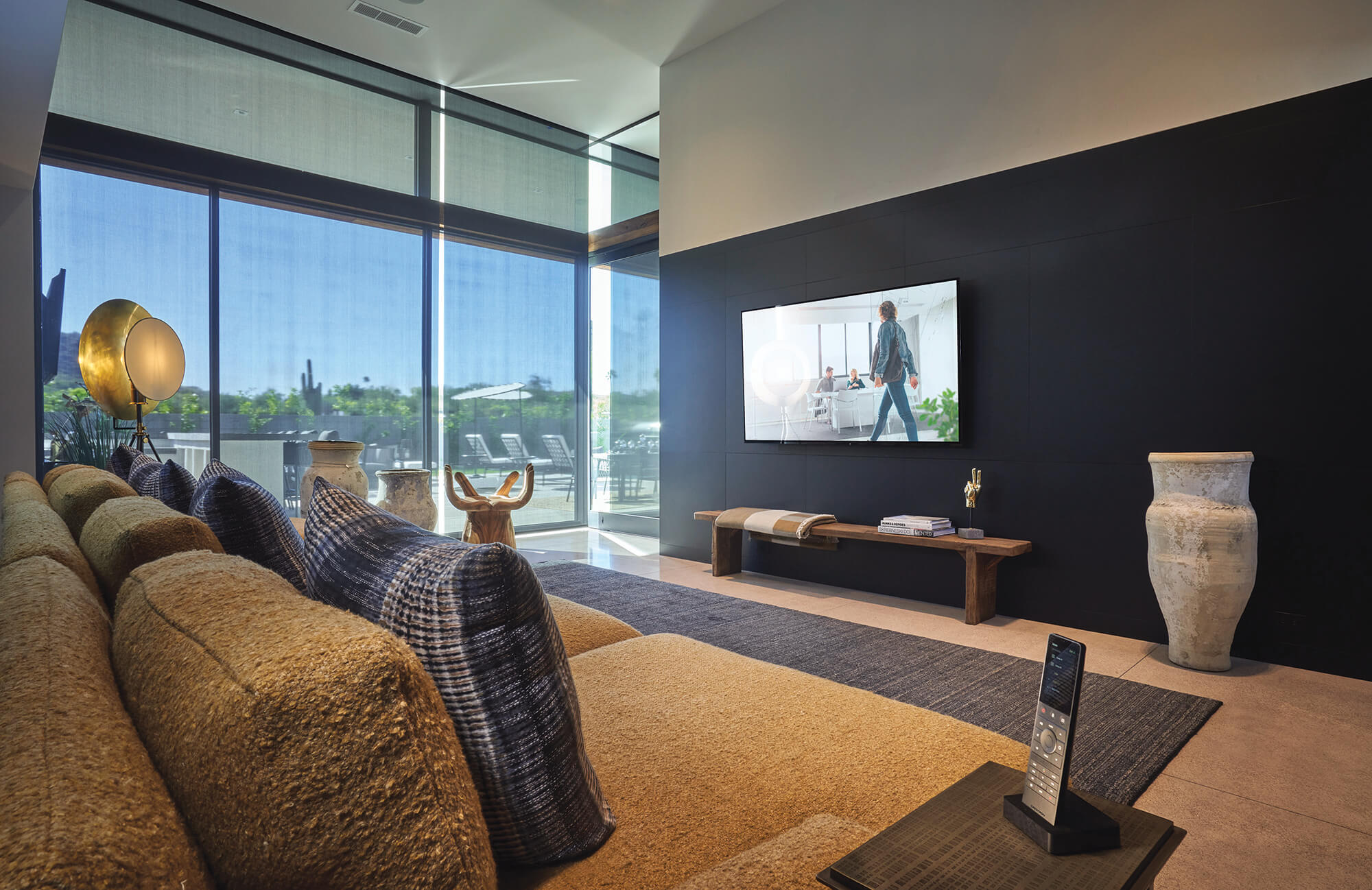
"These tips aren't what everyone is doing," she says. "These tips are what I see most typically across my own clients." And if there's one thing Martin has learned after so many years inside the homes, and minds, of Fortune 500 executives, founders and legacy families, it's this: Smart tech only works when it supports the way you live.
"For our clients, luxury is no longer defined by how many devices they own, but how little they have to think about them."
Full Automation Or DIY?
Crestron Electronics has worked with ultra-high-net-worth homeowners on the tech for many of the world’s most exclusive residences, penthouses, compounds and superyachts. “For our clients, luxury is no longer defined by how many devices they own, but how little they have to think about them,” says Michael Short, vice president of marketing operations and residential at Crestron. “When a home can naturally support your rhythms, protect your family and feel familiar whether you’re in the city apartment, the beach house or on the water, that’s when technology stops being a feature and becomes part of the lifestyle.”
Martin agrees. “Back in the 1990s, clients were far more enamored with the technology and needed racks of hardware just to make it work,” she says. “Now you can create a semi-smart home without relying on a professional just to turn it on and off.”
Today, brands such as Nest, SimpliSafe, Ring and Control4 let homeowners tailor systems to their comfort level. Some clients still want the full Lutron, Crestron or Savant command center—“maybe a third,” Martin estimates—but many prefer something lightweight, customizable and easily accessible from their phone.
Build For How You Use Media
Two decades ago, clients wanted full-fledged theater rooms with built-in projectors, stepped seating and acoustical paneling. Today, the technology has outpaced the need. Ultra-thin OLEDs, stunning micro-LED displays and smart TVs with cinemagrade sound processing have made the dedicated theater room—once the pinnacle of luxury—largely superfluous.
“There’s definitely less of that ‘gathering around the TV’ moment and more personal media use,” Martin says. “People don’t want to wire a whole house for music as much anymore.”
Instead of centralized media temples, her clients are building beautiful moments of flexibility: a 100-inch OLED in the living room, a Sonos speaker or a pair of noise-canceling headphones in the bedroom, an iPad that also sometimes doubles as a travel companion, etc.
Entertainment hasn’t disappeared; it’s simply become individualized. And thanks to the leap in quality across screens and speakers, you no longer need an acoustically sealed room to enjoy a cinematic night in.
"People don't want to wire a whole house for music as much anymore."

Connectivity Is The Cornerstone
If there’s one hill Martin is willing to die on, it’s Wi-Fi.
Across all setups, one requirement is non-negotiable: flawless connectivity. Dead zones are a dealbreaker in sprawling estates or brownstones. “Like everyone, my clients freak out about Wi-Fi the most,” she says. “It’s the first thing we test—no dropped calls, no streaming interruptions.”
High-end routers (Ubiquiti, Netgear Orbi, Eero Pro) plus strategically placed extenders are now fundamental infrastructure, right up there with HVAC and plumbing. In one recent 3,000-square-foot apartment remodel, the main router feeds the network, but five additional repeaters ensure every corner is covered. The client’s tech team even walked the space to confirm full coverage. As Martin says, “There’s no dropping any calls in that apartment.”
Longevity, Not Annual Upgrades
Her clients don’t want to update their homes along with their phones every two years. “In my 30 years,” she says, “I’ve never been asked to come back and update something. People learn to use what they have, and they live there.”
That means avoiding overly proprietary systems and choosing tech that ages gracefully—lighting controls that won’t be obsolete in three years, modular audio and security devices you can replace without ripping open walls.
Less Can Always Be More
Minimalism can be luxe—no dashboards, no logins, no software updates at inconvenient times. Just acoustically quiet home offices, good lighting and yes, reliable Wi-Fi, because even the tech-averse still need to be reachable.