I’ve been thinking about Tesla a lot recently. No, not the car company, the brilliant, but-notexactly-famous inventor for whom it was named: Nikola Tesla. If you’re aware of him, it’s probably in relation to his long-running feud with Thomas Edison. But the Serbian American contributed far more to the modern world than the crude caricature he left behind, most notably helping to bring alternating current into the mainstream—and into our homes— laying the groundwork for pretty much everything that plugs into a wall.
But more than his achievements, it’s an apocryphal quote, often attributed to Tesla, that I can’t seem to shake: “You may live to see man-made horrors beyond your comprehension.” Supposedly, he said it in reference to a radio-controlled rowboat. If so, such an invention would be considered far too quaint now, what with swarms of drones patrolling battlefields in Ukraine, Kalshi putting near-even odds on artificial general intelligence (AGI) by 2028 and LLMs threatening to turn white-collar workers of my ilk obsolete.
Maybe it’s just me, but that “may” used in that Tesla quote feels kind of superfluous—the modern world doesn’t leave much room for doubt.
So, how does one protect oneself? If your net worth is an eye-wateringly large number, it’s certainly not with a single Ring camera on the front door. But there are certainly more robust options that can have a real impact on home security—and the higher your available funds, the more advanced your system should be.
Tait Reimers, a director at SureFox North America, calls it an arms race between the threats and the protections.
“With the rapid rise of technology, it actually leaves these ultra-high net-worth individuals more exposed,” Reimers says. “It’s a strange dynamic; the ubiquity of it creates more vulnerability, not less.” Examples include corporate espionage targeting executives working from home, drones flown under the guise of real estate photography that are casing properties for vulnerabilities and increasingly sophisticated hacking efforts. And that’s without getting into what AI can do now: deepfakes and cloned voices that cybercriminals are using to convincingly request money or sensitive information.
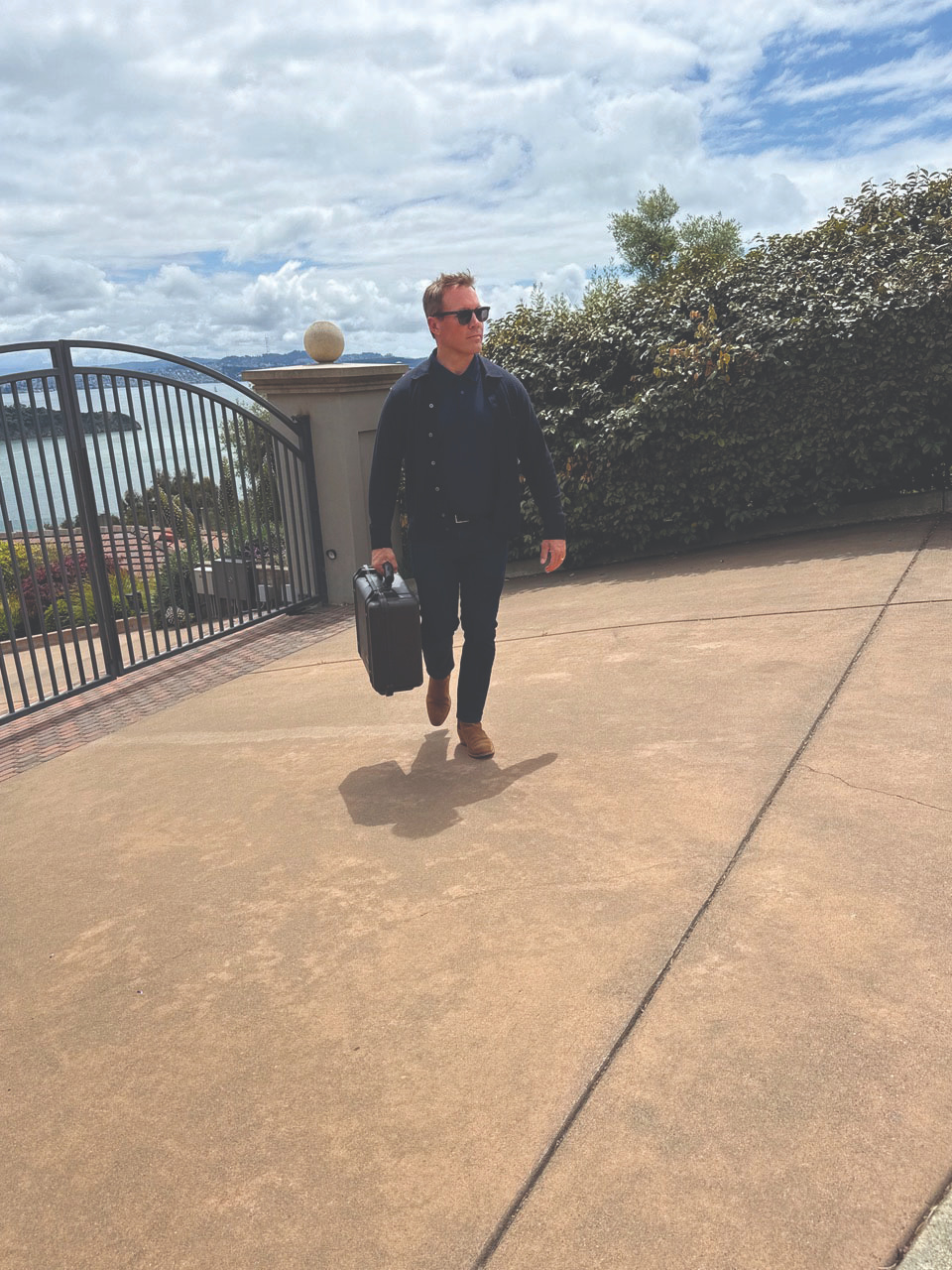
Reimers would know. A former US Navy SEAL with a background in corporate security at Tesla, Meta (Facebook) and Amazon, he once served on the personal security detail for Bill Gates. Today, he advises everyone from technocrats on remote islands to wealthy homeowners trying to safeguard their mega mansions from break-ins.
If you think the latter only happens on hit shows such as Your Friends & Neighbors, consider Tiburon, CA, an affluent enclave just outside San Francisco where Reimers lives. Since December 31, 2021, there’ve been 16 break-ins in lower Marin County, CA, according to police. As of this writing, the three men believed to be responsible have yet to be arrested.
Reimers points to a bigger structural issue underneath it all: law enforcement is stretched thin, underfunded and often hamstrung by what it can realistically pursue—which helps explain why a break-in occurs every 28 seconds in the US, according to 2019 FBI data. Property crime, as the saying goes, “does no time.” By the time someone has moved stolen goods—designer bags, jewelry, artwork— across international borders and into a broader black-market network, the trail has gone cold. The follow-up work can take months or even years, and most departments simply don’t have the investigative bandwidth to keep up.
“You watch CSI and other television shows like it and you think, it’s all over for these guys, right?” Reimers says. “In reality, they usually do get away with it.”
So, what’s to be done about it? We’ll start at the private-jet-on-standby end of the spectrum. For these public figures, protection means residential security teams posted 24/7 at the home, agents moving with the principal and roundthe-clock intelligence gathering to inform every step in between. (If that sounds like security befitting a president, you’re not far off.) Reimers describes these clients needing a kind of “protective concierge”— deterrence, logistics and friction removal all at once. Sounds like a plan.
Below this specialized tier are firms that help secure the physical stack: sensors and cameras designed to continually monitor a property. The model works, but it’s expensive and uneven, with quality varying widely depending on the provider.
What’s changing is the intelligence layer. Firms such as SureFox are pushing toward AI-driven, intelligenceled systems that actually interpret what those cameras see. Instead of passive recording, computer vision flags weapons, intrusion patterns or behavior that deviates from baseline, while multimodal setups blend video, infrared and other inputs to reduce blind spots and extend coverage into low visibility. It’s not seamless—false positives happen—but it allows leaner teams to do more with less and starts to shift security from manpower-heavy protection to something closer to continuous, networked awareness.
Will it stop someone from finding your home address online and showing up to
your gates with a Molotov cocktail? Harder to say. But in both these cases—
the shocking attack on Sam Altman’s $27 million compound in San Francisco and
the unsettling string of home invasions in Tiburon—robust video surveillance
either spooked the masked assailants or helped to swiftly identify the perp
responsible. And in the age of doomerism, with old warnings coming to fruition
seemingly every day, that begins to look like a win. As always, safety first.